

The Dark Legacy of Revolutionary France

The very mention of the French Revolution can cause some reaching for smelling salts over thoughts of the horrors and shudders of people being dragged to the guillotine. You read the political stirrings of cauldrons of evil and power hungry minds showed no compassion for the suffering of the people they supposedly claimed to champion for. Even the ‘peasants’ eventually suffered from under the Revolution. From an American perspective, the new chant seemed more of “Kill the Nobles and the Elites ..and the rich , and whoever gets in the way. If that wasn’t enough, classification extended to “notables” was installed. The radical Louis Antoine Saint Just, unashamedly said ” That which constitutes a Republic, is the total destruction of that which opposes it” I would call that annihilation. Ironically he was christened ‘The Angel of Death’.
Pushing aside abject horror, the fact is, not all of the French people who were condemned to death were executed by the guillotine. A good many many more were executed by firing squads, drownings, murder, massacres, sieges, or died languishing in over-crowded prisons only later to be faced by a firing squad or shot while they were still behind bars. Thousands died without proof of crime, or without a trial, and thus no record of it is found. Many who were judged by a tribunal, commission or military court were executed but also were given sentences of deportation to French Guinea, or were incarcerated for a number of years.
Contrary to popular belief, many more, much more ‘peasants’ and of the lower class people were executed or put to death, than those snooty, rich, money-grubbing and heartless nobles, elites, and the untouchable Catholic hierarchy. Death sentences were given to anyone thought to be a rebel, ‘terrorist’, traitor, or those deemed as entertaining anti-revolutionary thoughts. Outlawed Catholic priests or clerics (called refractory) who rejected allegiance to the new Constitution over the Church’s authority. (i.e. Pope) were put to death. Three young women of the same family (BÉRON) were executed for such a crime as hiding a Catholic priest..
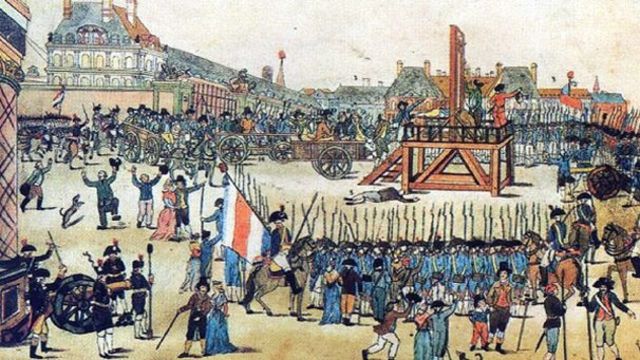
In Paris; executions were a family affair, jeering crowds and cheering as one new enemy after another were sent to the guillotine. People condemned to death as a conspirator, or for assassination attempts on ’cause celebre’ (such as Robespierre), had the distinction of wearing ‘une chemise rouge’, a red shirt of some kind to denote their ‘hideous’ crime, on their way to the guillotine.? Not all, but most cases of conspiracies were judged in Paris, then the condemned were executed. According to Greer’s calculations, Revolutionary justice meted out 2,639 death sentences during the Terror by the Tribunal Révolutionaire.1
Let me introduce you to one of the most notorious mass murderer of his time, Jean-Pierre Carrier. A ruthless and soulless figure sent by the new “Committee of Public Safety” with orders to ‘purge the city of Nantes2 of enemies of the Republic.. And purge he did. Thus starts the murders, then the massacres of any whom were denounced as ‘enemies’, whether they were or not. No proof, no trial, just the word of a ‘sans-culottes’ or anyone wanting to make a few bucks.
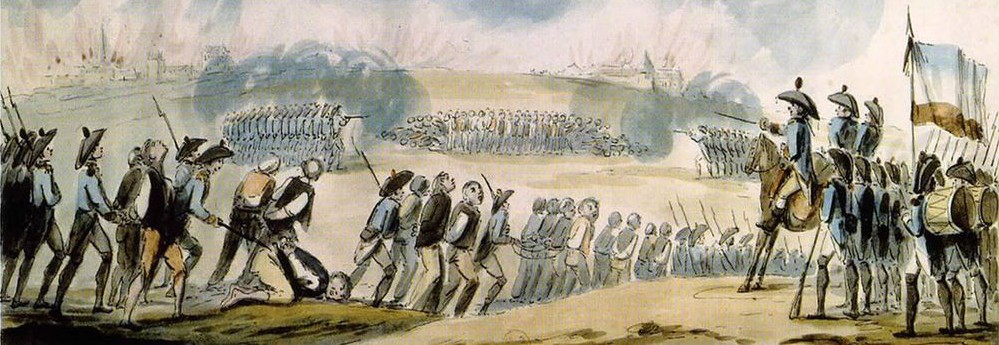
New methodologies to murder the citizens of Nantes en masse were installed. Guillotine (too time consuming), hanging (ditto) firing squads (too many bullets), and mass drownings. It seems Carrier couldn’t murder scores of people fast enough. No one was safe; men, families, crying women and children were either marched out to fields to be shot, or dragged out in the middle of the night, strapped together, placed on a boat, sailed out on the Loire River, and intentionally rigged to sink and drown all prisoners. He sneered as people begged for their lives and laughed as they suffered and died. Some early historians have written that at least 32,000 men including brigands, counter-revolutionists, blurred lines of the men of means, common man, tradesmen, peasants and those in between lost their lives in Nantes.
Louis M Prud’homme wrote two volumes (in French) ‘ Dictionnaire des individus envoyés à la mort judiciairement: révolutionnairement et contre-révolution, pendand la révolution France ‘ You can find these volumes here. Explore the index /census of names of the unfortunate and condemned victims who faced arrest and execution of the French Revolution between 1792-1796. Other sources you will find, are the Rathelot collection of ‘Extraits‘ of what was left of archival documents after the Communards3 burned Paris City Hall in 1871, and the Tribunal Révolutionaire (in Paris) of 10 volumes can be found here. Search for ancestors, historical figures, victims and villains, of the recorded information that was available at the time. This is an ongoing project..
As I conclude, Not all executions were recorded; the true account of lives lost in the Revolution have been debated by historians; Not all of the genealogical information surrounding the condemned were available or recorded. For example, if the victim was charged and sentenced as a ‘brigand of the Vendée, you might find very little information about them, which could include place of birth. Across France, thousands were slain in wars or in city sieges. Early historians who lived through the Revolution, have written of varying accounts of the population number4 of the executed, the people killed without trial (murder). One source estimated that roughly 400,000 people lost their lives while others research put the number around 14,000 to 18,000 executions.
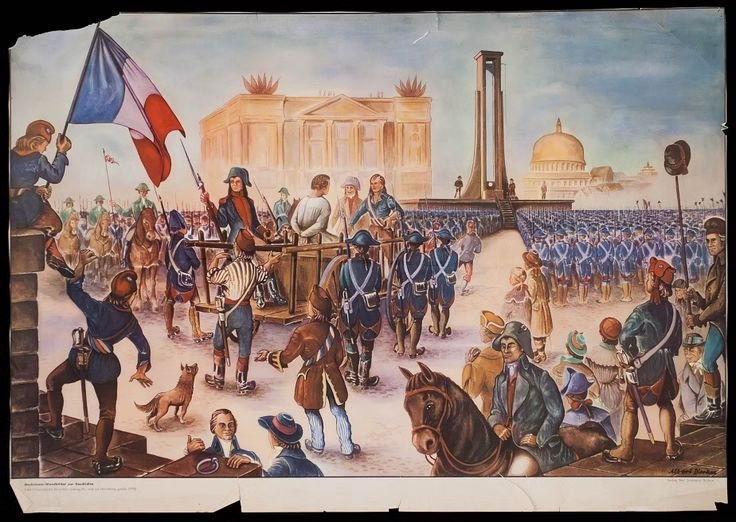
To gather a more concise statistical break down of those who died and where, as well as a short summary of the key players and the evolution of the Reign of Terror, I strongly suggest visiting Hathitrust for “The incidence of the terror during the French Revolution; a statistical interpretation” by Donald Greer. for every statistical breakdown you could possibly imagine. It is a 224 page book, all sourced and citied.
*I’m a lay historian who loves diving into the drama of the French Revolution, and apply sarcasm as I see fit. I’m not an ‘expert’ in this field. There are many scholars who are. They’re all over the internet, in books and lectures in University halls. The historians and authors I draw upon are those legal minds who lived through from the French Revolution era and wrote from documented facts as they knew them at the time.. Unfortunately most of the volumes is in French. I can read and understand some of the writing but not enough to grasp the depth, political fire and maneuvers. Invented laws by radicals, and legal decisions of the historical texts. But not all is lost, as some of the Revolutionary books I have, have been translated into English. You can find all matter of them at ForgottenBooks.
- The incidence of the terror during the French Revolution; a statistical interpretation, by Donald Greer, page 135 https://babel.hathitrust.org/cgi/pt?id=mdp.39015002601550&seq=157 ↩︎
- Mark, Harrison W.. “Drownings at Nantes.” World History Encyclopedia. Last modified November 02, 2022. https://www.worldhistory.org/Drownings_at_Nantes/. ↩︎
- The Paris Commune of 1871: Radicalism and Repression /https://explaininghistory.org/2025/05/11/title-the-paris-commune-of-1871-radicalism-and-repression/ ↩︎
- Ibid , II page 25, ‘The Victims of the Terror, ‘https://babel.hathitrust.org/cgi/pt?id=mdp.39015002601550&seq=47 ↩︎